Updated on November 9, 2026 · By the Smart Picks UAE team
Smart Picks UAE is reader-supported. As an Amazon Associate we earn from qualifying purchases, at no extra cost to you. Read our affiliate disclosure.
Quick answer — how to do a push up
- Place your hands slightly wider than your shoulders, under the shoulder line.
- Step your feet back so your body is one straight line from head to heels.
- Brace your core and squeeze your glutes so the hips do not sag.
- Bend your elbows to about 45 degrees from your body and lower your chest toward the floor.
- Press the floor away until your arms are straight, without shrugging.
- Stop the set when your form slips, not when you are completely exhausted.
The push-up is one of the simplest strength exercises: no machine, no weights, just you and the floor. It is also easy to do badly. This guide shows how to do a push up with solid form, how to scale it if you are new, and how to keep progressing once the basics feel easy.
It is written for beginners and returning exercisers who want a clear, safe plan. If you are building a pulling routine too, pair it with our guide on how to do a pull up.
This article is general fitness information, not medical advice. If you have wrist, shoulder or elbow pain, a recent injury or a medical condition, check with a qualified clinician before starting.
How to Do a Push Up: Step-by-Step Form
The NASM exercise library describes the push-up as a compound upper-body exercise that trains the chest, triceps and shoulders while demanding core stability. Here is how to do a push up in four parts.
1. Set up in a plank
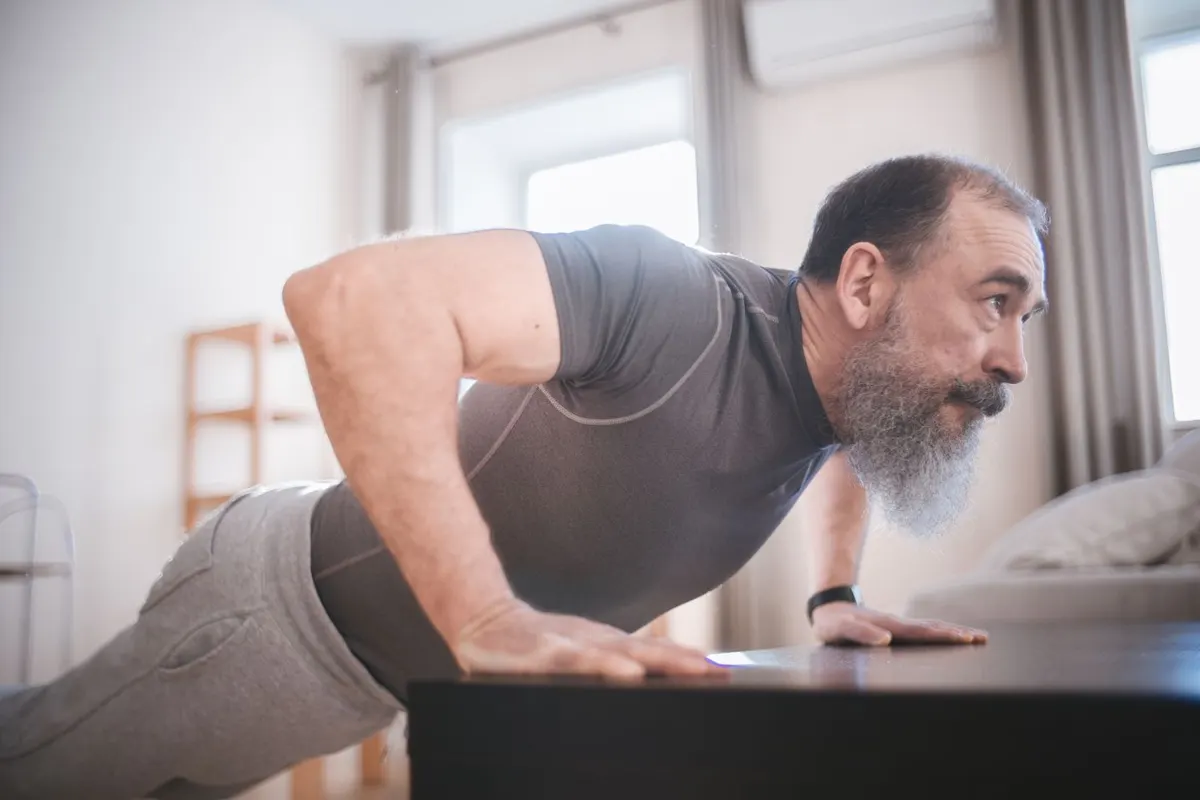
Start on your hands and toes with your hands a little wider than shoulder-width and your feet together or hip-width apart. Spread your fingers and press evenly through the whole palm. Your wrists should sit roughly under your shoulders.
2. Brace and line up
Draw your ribs down, tighten your abs and squeeze your glutes. Look at a spot on the floor slightly ahead of your hands so your neck stays long. From the side, your head, hips and heels should form one straight line.
3. Lower with control
Bend your elbows and lower your whole body as one piece until your chest is close to the floor, or your elbows reach around 90 degrees, whichever your mobility allows. NASM suggests keeping the elbows about 45 degrees from your torso rather than flaring them straight out to the sides, which tends to stress the shoulders.
4. Press back up
Push the floor away and return to the start in the same straight line. Avoid snapping the elbows into a hard lockout, and do not let the hips lead the way. A good rep takes about two seconds down and one second up.

Muscles Worked by a Push Up
According to NASM, the main movers are the pectoralis major (chest) and the triceps, with the front of the shoulder, serratus anterior, pectoralis minor and core stabilizers assisting. That mix is why push-ups feel like a full upper-body and trunk exercise instead of an isolated chest move.
How to Do Push Ups for Beginners
If a floor push-up is out of reach today, do not rush it with a half rep and a sagging back. How to do push ups for beginners comes down to reducing the load while keeping the same body line. The three most common options are:
- Incline push ups: hands on a stable counter, bench or table. The higher the surface, the easier the rep.
- Wall push ups: a gentle starting point for people who are rebuilding strength.
- Knee push ups: shorter lever, but keep a straight line from head to knees.
Pick the version where you can finish 8–12 smooth reps with a straight body. Train two or three days a week, leave a day between sessions, and add a couple of reps each week. If you are still building a base, our beginner dumbbell exercises make a good partner to push-ups on separate days.
Push Up Progression: From Incline to Floor
A simple push up progression makes you stronger without guesswork. Move to the next stage only when the current one looks identical from rep one to rep last. The timings below are a starting point, not a guarantee; repeat a stage whenever form slips.
| Stage | How to do it | Starting volume | Move on when |
|---|---|---|---|
| Wall push up | Hands on a wall at chest height, body slanted, lower the chest toward the wall | 3 × 10–15 | Reps feel smooth and easy |
| High incline | Hands on a counter or sturdy table, straight body line | 3 × 8–12 | You can do 12 clean reps |
| Low incline | Hands on a bench, sofa arm or low step (stable only) | 3 × 8–12 | You can do 12 clean reps |
| Full push up | Hands on the floor, chest nearly touching down | Sets of 3–8, stop 1–2 reps short | 8–10 clean reps per set |
| Variations | Close-grip, decline, pike, tempo or handle push ups | 3 × 6–12 | Form stays identical to your standard rep |
For extra challenge on the way up, a long loop band across your upper back adds resistance at the top of the rep. A set such as TheFitLife resistance bands also works for rows and shoulder warm-ups; our resistance bands guide explains how to choose a set.
How to Do Push Ups at Home
Knowing how to do push ups at home is mostly about space and surface. You need an area roughly the length of your body, a non-slip floor and something comfortable under your hands. A yoga or exercise mat is enough for many people; interlocking foam tiles such as the PROIRON foam mats add cushioning and keep the floor from slipping, which is handy in a small apartment.
If your wrists complain on a flat floor, push-up handles keep the wrist straighter and let your chest travel a little deeper. A basic pair like the PROIRON push-up bars is an inexpensive way to test whether handles suit you. For more compact ideas, see our guide to home gym equipment for small spaces.
Push Up Variations to Try Next
Once you can complete 8–10 clean standard reps, push up variations change which muscles work hardest and keep training interesting. NASM lists the modified, incline, decline, plyometric and pike push-up among the common options. Add one new variation at a time and keep your standard push-up in the mix.
| Variation | What changes | Best for |
|---|---|---|
| Incline push up | Hands raised, less body weight pressed | Beginners building up to the floor |
| Knee push up | Knees down, shorter lever | Learning the pattern with a full range of motion |
| Close-grip (triceps) push up | Hands closer under the chest | More triceps work |
| Decline push up | Feet raised on a stable surface | More upper-chest and shoulder load |
| Pike push up | Hips high, head moves toward the floor | Shoulder strength |
| Tempo push up | 3–4 seconds lowering phase | Control and muscle endurance |
Parallettes can add a deeper range of motion for advanced push-ups and also support L-sits and dips. A sturdy low pair such as the Yes4All parallettes suits people who have outgrown basic handles and want to progress to harder variations.
Common Push Up Mistakes
- Sagging hips. NASM flags this as a sign the core has switched off. Squeeze the glutes and abs harder, or use an easier incline.
- Flared elbows. Elbows straight out to the sides increase shoulder stress. Aim for about 45 degrees.
- Half range of motion. If your chest never gets close to the floor, regress to an incline and own the full range.
- Jerky reps. Momentum hides weak spots. Slow the lowering phase down.
- Head dropping or jutting forward. Keep your neck in line with your spine.
- Hips piked up. A high bottom shortens the lever and turns the move into a pike push up by accident.
A Simple Weekly Push Up Plan
Two to three sessions a week works for most beginners. Here is one example:
- Day 1: 4 sets on your current progression stage, stopping 1–2 reps short of failure.
- Day 2: Rest or easy walking.
- Day 3: 3 sets of the same stage, with a 3-second lowering phase.
- Day 4: Rest.
- Day 5: Test one set of your target stage. If you reach 8–10 clean reps, move to the next stage next week.
Mild muscle soreness is normal. Sharp joint pain is a cue to scale back, not to push through it.
Helpful gear for push ups at home
None of this is required — push-ups work fine with bodyweight alone. Prices change often, so check Amazon.ae for the current price.
- PROIRON push-up bars — Simple handles with foam grips to keep wrists straighter.
Check price on Amazon.ae → - Yes4All parallettes — A step up for deeper push-ups and other bodyweight skills.
Check price on Amazon.ae → - TheFitLife resistance bands — Add resistance to push-ups or warm up your shoulders.
Check price on Amazon.ae → - PROIRON interlocking mats — A cushioned, non-slip surface under your hands and knees.
Check price on Amazon.ae →
Frequently Asked Questions
How do I do a push up if I can’t do one yet?
Start with an incline version: hands on a sturdy table, counter or bench so your body forms a straight slope. Lower the surface over a few weeks until you reach the floor. Wall and knee versions also work, as long as you keep the hips and shoulders in line.
How many push ups should a beginner do?
There is no universal number. Do sets that stop one or two reps before your form breaks, for example 3 sets of 5–10 on an incline, two or three days a week. Add reps first, then lower the incline.
What is the correct push up form?
Hands slightly wider than your shoulders, body in a straight line from head to heels, elbows at roughly 45 degrees, chest close to the floor, then press back up without locking out hard or letting the hips sag.
What muscles do push ups work?
Mainly the chest (pectoralis major) and triceps, with help from the front of the shoulders, the serratus anterior and the core muscles that keep your body rigid.
Can I get stronger with push ups at home without equipment?
Yes. Changing the angle, tempo and hand position gives plenty of progression with only bodyweight. Equipment such as push-up handles or bands is optional, not required.
Are push up handles worth it?
They can ease pressure on the wrists and allow a deeper range of motion, but they are not essential. If wrist discomfort is your main issue, try fists, handles or a neutral-wrist grip and see which feels best.
Bottom Line: How to Do a Push Up
Learning how to do a push up is about a straight body line, steady elbows and a full range of motion, not a heroic number of sloppy reps. Start at an incline that lets you move well, follow a simple push up progression toward the floor, practise at home on a comfortable surface, and add push up variations once the standard rep looks easy. Stay consistent for a few weeks and the strength follows.