Updated on November 11, 2026 · By the Smart Picks UAE team
Smart Picks UAE is reader-supported. As an Amazon Associate we earn from qualifying purchases, at no extra cost to you. Read our affiliate disclosure.
Quick answer — how to do a kettlebell swing
- Stand with feet about shoulder-width apart, kettlebell on the floor a little in front of you.
- Hinge at the hips with a flat back and grip the handle with both hands.
- Hike the bell back high between your thighs.
- Snap your hips forward and stand tall so the bell floats to about chest height.
- Let it fall, hinge again as it passes between your legs, and repeat.
- Stop the set as soon as your back rounds or the arms start lifting the bell.
The kettlebell swing is one of the most useful exercises you can do with a single piece of equipment. It builds the glutes and hamstrings, gets your heart rate up quickly and fits in a small apartment corner. It also has a reputation for sore lower backs, and that almost always comes down to technique. This guide explains how to do a kettlebell swing step by step, which mistakes to avoid, and how to build a simple routine at home.
If you do not own a kettlebell yet, our guide to the best kettlebell for home workouts covers cast iron, neoprene and adjustable options available in the UAE, plus a weight table for beginners.
This article is general fitness information, not medical advice. If you have back, hip or shoulder pain, are pregnant, or have a medical condition, check with a qualified clinician before starting ballistic exercises like the swing.
What Is a Kettlebell Swing?
A kettlebell swing is a ballistic hip-hinge movement. You fold forward at the hips, load the glutes and hamstrings, then extend the hips explosively so the bell travels forward and up. The arms simply guide the kettlebell; they do not lift it. The American Council on Exercise (ACE) describes the swing as a horizontal movement: the body moves forward and back through the hips rather than up and down as in a squat.
There are two common styles. The Russian swing (sometimes called the hardstyle swing) finishes at about chest height and is the version we teach here. The American swing travels overhead; it needs more shoulder mobility and is better left until the standard swing is solid.
How to Do a Kettlebell Swing: Step-by-Step
Learning how to do a kettlebell swing is easier if you split it into five parts. Practise each part slowly before you link them into continuous reps.
1. Set your stance
Stand with your feet about shoulder-width apart, toes pointing forward or slightly out. Place the kettlebell on the floor roughly a foot in front of you, so it forms a triangle with your feet. Wear flat shoes or train barefoot on a stable, non-slip floor.
2. Hinge and grip
Soften your knees slightly, then push your hips back until your torso leans forward and your hands reach the handle. Keep your back long and your neck in line with your spine. Grip the handle firmly with both hands, palms facing you, and pull your shoulders gently down and back so your lats feel engaged.
3. Hike the bell back
Tip the kettlebell toward you and hike it back between your legs, aiming high toward your zip rather than down toward the knees. Your forearms should brush your inner thighs. This loads the hips like a spring.
4. Snap the hips forward
Drive your hips forward and stand up tall in one quick movement. Squeeze your glutes, brace your abs and let your knees straighten. The bell should float up to about chest height on its own. If it only reaches your waist, the hip snap needs to be sharper; if it goes over your head, you are lifting with your arms.
5. Let it fall and repeat
At the top, stay tall for a split second. As the bell falls, wait until it is close to your body, then hinge again and let it travel back between your legs. Breathe out sharply at the top and in on the way down. To finish, hike the bell back one last time and park it on the floor in front of you rather than dropping it from standing.
Kettlebell Swing Form: The Checklist
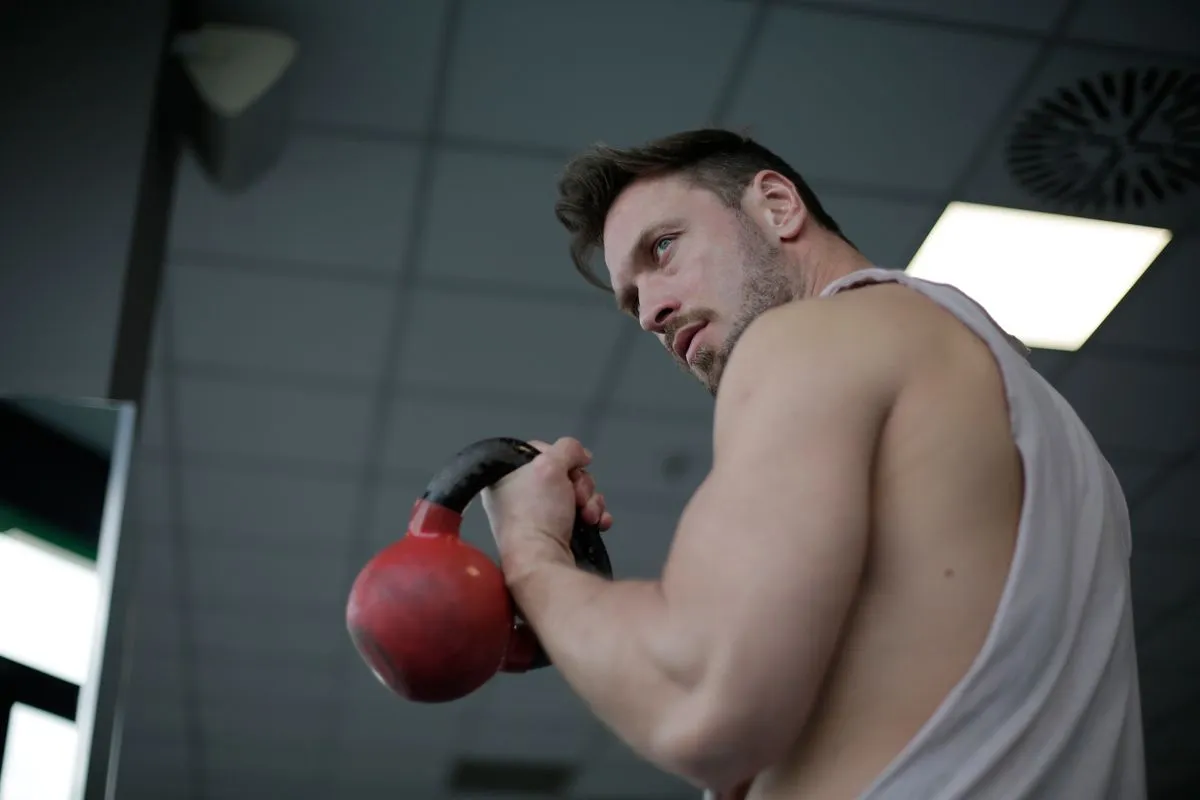
Good kettlebell swing form looks smooth and almost effortless. Run through this checklist on your first few sets, or film yourself from the side with your phone:
- Flat back at the bottom: your spine stays neutral from tailbone to head.
- Shins close to vertical: the knees bend a little, the hips do most of the moving.
- High hike: the bell passes above the knees, close to the groin.
- Full lockout: at the top you stand straight, like a plank standing up, without leaning back.
- Relaxed arms: they act like ropes connecting your hands to the bell.
- Controlled breathing: a short, sharp exhale at the top of each rep.
Common kettlebell swing mistakes
| Mistake | What it looks like | Fix |
|---|---|---|
| Squatting the swing | Knees bend deeply, bell moves up and down | Think “hips back”, not “sit down”; keep shins nearly vertical |
| Lifting with the arms | Shoulders do the work, bell goes overhead | Arms stay relaxed like ropes; height comes from the hip snap |
| Rounded back | Spine curls at the bottom of the swing | Lighter bell, shorter hike, keep the chest proud |
| Leaning back at the top | Ribs flare, lower back arches | Finish tall: squeeze glutes, brace abs, ribs down |
| Bell too low on the hike | Kettlebell swings near the knees | Keep it high, wrists close to the inner thighs |
ACE notes that turning the swing into a squat is the most common beginner error. If you catch yourself sitting down, put a box or chair behind you and practise reaching your hips back to touch it without letting the knees push forward.
Kettlebell Swings for Beginners: A Safe Progression
Kettlebell swings for beginners should start without any swinging at all. ACE recommends teaching the hip hinge first and moving to ballistic swings only after about 12–15 good kettlebell deadlifts. The progression below follows that idea. Spend at least a session or two at each stage, and repeat a stage whenever your form slips.
| Stage | What to do | Starting volume | Move on when |
|---|---|---|---|
| 1. Hip hinge drill | Hands on hips or a dowel along your back, push hips back and stand tall | 2–3 × 10 | Back stays flat and shins stay near vertical |
| 2. Kettlebell deadlift | Bell between the feet, hinge, grip, stand up by driving the hips | 3 × 8–12 | 12–15 smooth reps with a light bell |
| 3. Hike and park | Hike the bell back like a football snap, stand up, then park it on the floor | 3–5 × 5 | The hike feels controlled, not rushed |
| 4. Two-handed swing | Continuous swings to about chest height | 5–8 × 10, rest 30–60 s | All reps look the same from first to last |
| 5. Progress | Heavier bell, more sets, timed intervals or one-arm swings | Change one variable at a time | Form stays identical |
Choose a starting weight you can deadlift comfortably for 15 reps. A plain cast iron bell such as the PROIRON cast iron kettlebell has a wide, smooth handle that suits two-handed swings. If the bell feels too heavy to control, go lighter; a weight that is a little too easy teaches better habits than one that is too hard.
Kettlebell Swings Muscles Worked
When people search for kettlebell swings muscles worked, the short answer is: most of the back of your body. The swing is a hip-extension exercise, so the main movers are:
- Glutes: they produce the hip snap that drives the bell forward.
- Hamstrings: they stretch under load during the hinge and help extend the hips.
- Spinal erectors: they hold the back flat while the bell pulls you forward.
- Core: the abs and obliques brace at the top so you finish tall instead of arching.
- Grip, lats and upper back: they hold the handle and keep the bell close on the backswing.
Because the swing trains the posterior chain, it pairs well with pushing and pulling work. Combine it with push ups and pull ups and you have a compact full-body routine.
Kettlebell Swing Benefits
The main kettlebell swing benefits come from combining strength and conditioning in one movement:
- Hip power: the explosive hip extension carries over to running, jumping and lifting.
- Conditioning in little time: ACE suggests intervals such as 30 seconds of swings and 30 seconds of rest for aerobic conditioning, which raises the heart rate quickly.
- Posterior-chain strength: useful if you sit at a desk or in traffic for long periods.
- Grip strength: holding a moving bell trains the hands and forearms.
- Small footprint: one kettlebell and about two square metres of floor are enough, which suits UAE apartments.
Swings burn energy, but no single exercise targets belly fat. If weight loss is your goal, see our list of full-body exercises for weight loss and pair training with sensible eating and enough protein per day.
A Simple Kettlebell Swing Workout at Home
Once your swing looks consistent, try this 15-minute session two or three times a week on non-consecutive days:
- Warm-up (4 minutes): 10 hip hinges, 10 glute bridges, 10 bodyweight squats, 5 slow kettlebell deadlifts.
- Swings (8 minutes): on every minute, do 10 two-handed swings and rest for the remainder of the minute.
- Finisher (3 minutes): 3 rounds of 8 push ups and a 20-second plank.
Progress by adding one or two rounds every week, then moving up to a heavier bell. In the UAE summer, train indoors with air conditioning or early in the morning, and keep water nearby; our guide to exercising in the UAE heat has more tips.
Set up your space
Swings need clear space in front of and behind you, so move furniture, keep pets and children away, and check that the ceiling and lights are not in the bell’s path. A firm floor is best. On tiles, a few interlocking foam tiles such as the PROIRON exercise mats protect the floor if you park the bell; avoid very soft mats that let your feet wobble. For more ideas on fitting a gym into a small flat, read our home gym equipment for apartments guide.
Kettlebell Swing Alternatives
If you do not have a kettlebell yet, or swings aggravate an old injury, these options train a similar pattern:
- Dumbbell swing: hold one dumbbell by the end with both hands and use the same hinge.
- Resistance band pull-through: anchor a band low behind you and drive the hips forward; see our resistance bands guide.
- Romanian deadlift with dumbbells: slower and easier to control; ideas in our beginner dumbbell exercises list.
- Glute bridge or hip thrust: no swinging at all, good for learning to use the glutes.
Helpful Gear for Kettlebell Swings
- PROIRON cast iron kettlebell — solid one-piece bell with a wide, smooth handle that suits two-handed swings.
Check Price on Amazon → - PROIRON neoprene-coated kettlebell — the coating is kinder to floors and quieter, handy in apartments.
Check Price on Amazon → - Amazon Basics cast iron kettlebell — a simple, no-frills painted bell if you just want one weight to start.
Check Price on Amazon → - PROIRON interlocking exercise mats — 2 cm foam tiles that protect tiles when you park the bell; not needed under the feet on a firm floor.
Check Price on Amazon →
FAQ
How do you do a kettlebell swing for beginners?
Learn the hip hinge first without weight, then hold a light kettlebell for a few sets of deadlifts. When that feels smooth, hike the bell back between your legs, snap your hips forward and let it float to about chest height. Start with short sets of 5–10 reps and rest well between them.
What weight kettlebell should a beginner use for swings?
Most beginners do well with a bell they can deadlift easily for 15 reps with perfect form. For many women that is roughly 8–12 kg and for many men roughly 12–16 kg, but your own strength and history matter more than any chart. Our kettlebell buying guide has a fuller weight table. For women, men and swing-specific weights, read what weight kettlebell should I start with.
What muscles do kettlebell swings work?
Mostly the posterior chain: glutes, hamstrings and the muscles along the spine. The core works hard to keep the trunk braced, and the grip, upper back and shoulders hold and guide the bell.
Why do kettlebell swings hurt my lower back?
Usually because the movement turns into a squat or a lower-back lift, the back rounds at the bottom, or the hips are not fully extended at the top so the spine leans back instead. Lower the weight, rehearse the hip hinge and stop if pain continues. See a qualified clinician for persistent pain.
How many kettlebell swings should I do a day?
There is no magic number. Two or three sessions a week with 5–10 sets of 10 good reps is a sensible starting point. Quality beats volume: end each set while the swing still looks crisp.
Can I do kettlebell swings with a dumbbell?
Yes. Hold one dumbbell vertically by one end with both hands and follow the same hinge pattern. It is a reasonable substitute, though the kettlebell handle and offset weight make the swing feel smoother.
The Bottom Line
Learning how to do a kettlebell swing comes down to one idea: hinge, do not squat, and let the hips do the work. Start with the hinge drill and deadlifts, keep the weight modest, and finish every rep standing tall. Done well, a few minutes of swings a week can build stronger hips, a sturdier back and better conditioning without leaving your home.