Updated on November 19, 2026 · By the Smart Picks UAE team
Smart Picks UAE is reader-supported. As an Amazon Associate we earn from qualifying purchases, at no extra cost to you. Read our affiliate disclosure.
Short answer: TPE vs PVC yoga mat: which is better?
For sweaty hands and hot UAE rooms, a good PVC mat usually grips better and lasts longer, because its dense, closed-cell surface stays tacky and does not soak up sweat. TPE is lighter, cheaper to replace and free of chlorine, but it can feel slippery when wet and wears out sooner.
Two mats can look almost identical on Amazon.ae and still behave very differently once your palms start to sweat in a warm Dubai living room. The difference usually comes down to one line in the listing: the material. Most budget and mid-range mats are made from either TPE (thermoplastic elastomer) or PVC (polyvinyl chloride), and choosing between them decides how well the mat grips, how long it lasts and how it smells when it arrives. This guide compares a TPE vs PVC yoga mat on the things that matter in the UAE: grip in heat and sweat, cushioning on tile floors, durability, safety and care. If you just want our product picks, see our guide to the best yoga mats in the UAE.
TPE vs PVC Yoga Mat: The Quick Comparison
Here is how the two materials compare at a glance. The scores are our general guide based on how each material behaves, not lab tests of a single product, and individual mats vary with thickness and surface texture.
| Feature | TPE yoga mat | PVC yoga mat |
|---|---|---|
| Dry grip | Good (soft, slightly tacky) | Very good (sticky, dense) |
| Grip with sweaty hands | Fair: often slippery | Good, especially closed-cell tops |
| Typical thickness | 6–10 mm | 4–6 mm |
| Weight (183 x 61 cm) | Light, about 0.8–1.2 kg | Heavier, about 1.2–2.5 kg |
| Cushioning on tiles | Soft and springy | Firmer, more stable |
| Typical lifespan (home use) | About 1 year | 2–5+ years |
| Smell when new | Mild | Can be noticeable for a few days |
| Eco profile | Chlorine-free, often recyclable | Harder to recycle |
| Price tier on Amazon.ae | Budget | Budget to premium |
Weights and lifespans are typical ranges from manufacturer listings and buyer reviews; check each product page for exact specs. Prices change, so check Amazon.ae.
What Is a TPE Yoga Mat?
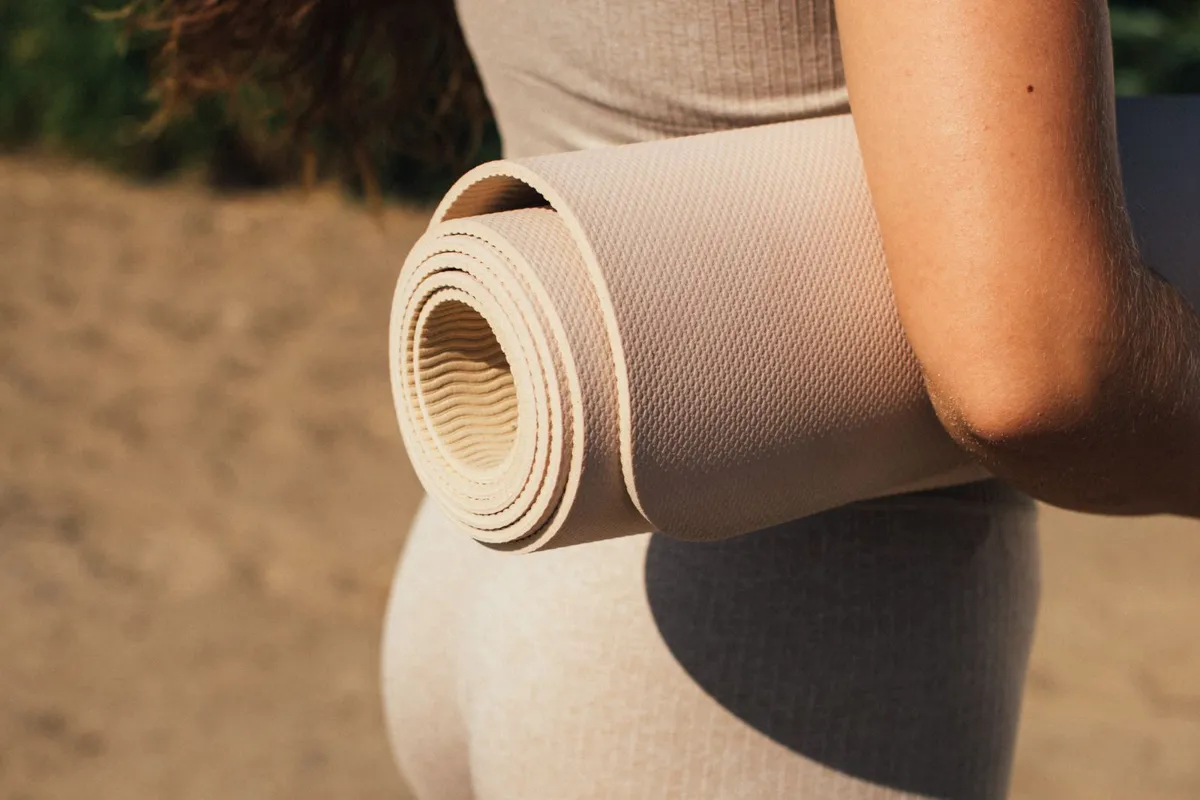
TPE is a blend of plastic and rubber-like polymers. It feels soft and springy, it is usually latex-free and it contains no chlorine. Most TPE mats are 6–10 mm thick, have a different texture on each side and weigh about a kilo, which makes them easy to carry to a studio or a park. A mat like the HERUI 6 mm TPE mat with alignment lines is a typical example: light, cushioned and affordable.
The trade-off is the surface. TPE is a closed-cell material, so it does not soak up sweat, but the sweat sits on top. On a dry day that is fine; in a warm room it can turn the mat slippery. TPE also dents and wears faster than PVC, particularly under knees and hands, and it does not cope well with heat, so a TPE mat left in a car in July will not last long.
What Is a PVC Yoga Mat?
PVC is the classic “sticky mat” material that yoga studios have used for decades. It is dense, slightly tacky to the touch and very durable. PVC mats are usually thinner than TPE (4–6 mm) but feel more stable, which helps with standing and balance poses. Premium options such as the Manduka PRO use a dense closed-cell PVC that resists sweat soaking in, and well-known everyday mats like the GAIAM 6 mm PVC yoga mat list a “6P free” formula, meaning they are made without six commonly restricted phthalates.
The downsides are weight, a plastic smell for the first few days, and the environment: PVC is made with chlorine and is harder to recycle. Very cheap, unbranded PVC mats can also feel slick until they are broken in.
Is TPE Better Than PVC? Grip in UAE Heat and Sweat
This is the question most UAE readers really care about, so here is our honest take on is TPE better than PVC for grip. On a dry mat in an air-conditioned room, both materials grip well and most people will not feel a big difference. The gap appears when you sweat. In the pattern of buyer reviews we checked, PVC holds its grip noticeably longer as hands and feet get damp, while TPE starts to feel slick in downward dog or plank after 15–20 minutes of a vigorous flow.
That matters here. Even with the AC on, many UAE flats sit at 24–27°C, and hot yoga studios in Dubai and Abu Dhabi run far warmer. Humidity along the coast also keeps skin damp. If you practise power yoga, hot yoga or sweat heavily, PVC is the safer choice. If you mostly stretch, do Pilates or gentle yoga, TPE is perfectly fine.
| Your practice | Better material | Why |
|---|---|---|
| Hot yoga or Bikram | PVC + towel | Grip holds as you sweat; a towel adds absorbency |
| Vinyasa or power yoga at home | PVC | Stable for standing poses, stays tacky longer |
| Gentle yoga, stretching, meditation | TPE | Soft, light and cheaper |
| Pilates mat work and core | TPE (8–10 mm) | Extra cushioning for the spine on hard tiles |
| Travel and studio carry | TPE | About half the weight of many PVC mats |
Best Yoga Mat Material for Sweaty Hands
If sweaty hands are your main problem, the best yoga mat material for sweaty hands is a closed-cell PVC or a polyurethane (PU) top, followed by natural rubber. Rubber and PU are usually more expensive, and rubber is heavy and not suitable if you have a latex allergy. Whatever you choose, these habits make a bigger difference than most people expect:
- Use a grip towel: a microfibre towel with silicone dots, such as the Eunzel non-slip yoga towel, absorbs sweat and grips the mat underneath. Lightly mist it with water before you start.
- Wash your hands and feet before practice to remove moisturiser and sunscreen, which make any surface slippery.
- Break in a new PVC mat by wiping it with a damp cloth and using it regularly for a week or two.
- Keep the room cool: practise in the morning or set the AC a couple of degrees lower during your session.
- Clean the mat often: body oils build up and reduce grip on both materials.
EVA vs PVC vs TPE Yoga Mat: Where Does EVA Fit?
When you search Amazon.ae you will also see EVA foam mats, so it is worth comparing EVA vs PVC vs TPE yoga mat options in one place. EVA is the cheapest of the three. It is light and cushioned, which is why it is common in kids’ mats and very low-cost exercise mats, but it compresses quickly, tears at the edges and gets slippery when wet. NBR foam, used in many thick 10 mm “exercise mats”, behaves similarly: great for floor work and knees, less good for grip.
| Material | Grip (wet) | Durability | Weight | Best for |
|---|---|---|---|---|
| EVA foam | Poor | Low | Very light | Kids, occasional stretching |
| NBR foam | Fair | Medium | Light | Thick floor-exercise mats |
| TPE | Fair | Medium | Light | Beginners, travel, gentle yoga |
| PVC | Good | High | Medium-heavy | Regular yoga, sweaty hands |
| Natural rubber / PU | Very good | High | Heavy | Hot yoga, serious practice |
For a thick, cushioned mat for home workouts and stretching, a budget option such as the SKY-TOUCH 10 mm TPE mat makes sense. For regular yoga with sweaty hands, step up to PVC.
Is a PVC Yoga Mat Toxic? Safety and Smell Explained
Many readers ask is a PVC yoga mat toxic. Older PVC products were often softened with phthalates, which some health agencies have restricted. Most reputable mat brands now sell phthalate-free PVC and say so on the listing, using labels such as “6P free” or an OEKO-TEX STANDARD 100 certificate. These labels are worth looking for, especially if you have young children who play on the mat.
A new PVC mat can smell of plastic for a few days. Unroll it in a ventilated room, away from direct sun, and the smell usually fades within a week. TPE generally has a milder smell from the start. If any mat has a strong chemical odour that does not fade, or irritates your skin, stop using it and contact the seller. On the environmental side, TPE is the better choice: it contains no chlorine and is more often recyclable, while PVC is difficult to recycle.
Cushioning and Stability on UAE Tile Floors
Most UAE apartments have tile or marble floors, which are hard on knees and wrists. Thickness matters as much as material here. A 4–6 mm PVC mat is stable and firm, ideal for standing poses, but you may want a folded towel under your knees. An 8–10 mm TPE mat cushions far more, which is great for Pilates and floor work, but it can feel wobbly in balance poses. Both materials grip smooth tiles well when the floor is clean; a dusty or freshly mopped floor is what usually makes a mat slide.
If you also do strength training on the same floor, our guide to home gym equipment for apartments covers floor protection, and our Pilates kit guide explains what else you need for mat-based classes at home.
How to Care for TPE and PVC Mats in the UAE
- Wipe after every session with a damp cloth or a mild, mat-safe cleaner. Avoid harsh solvents, which can make PVC sticky and TPE brittle.
- Dry in the shade: direct UAE sun degrades both materials quickly and can fade or crack them.
- Never store a mat in a parked car; summer cabin temperatures can warp TPE.
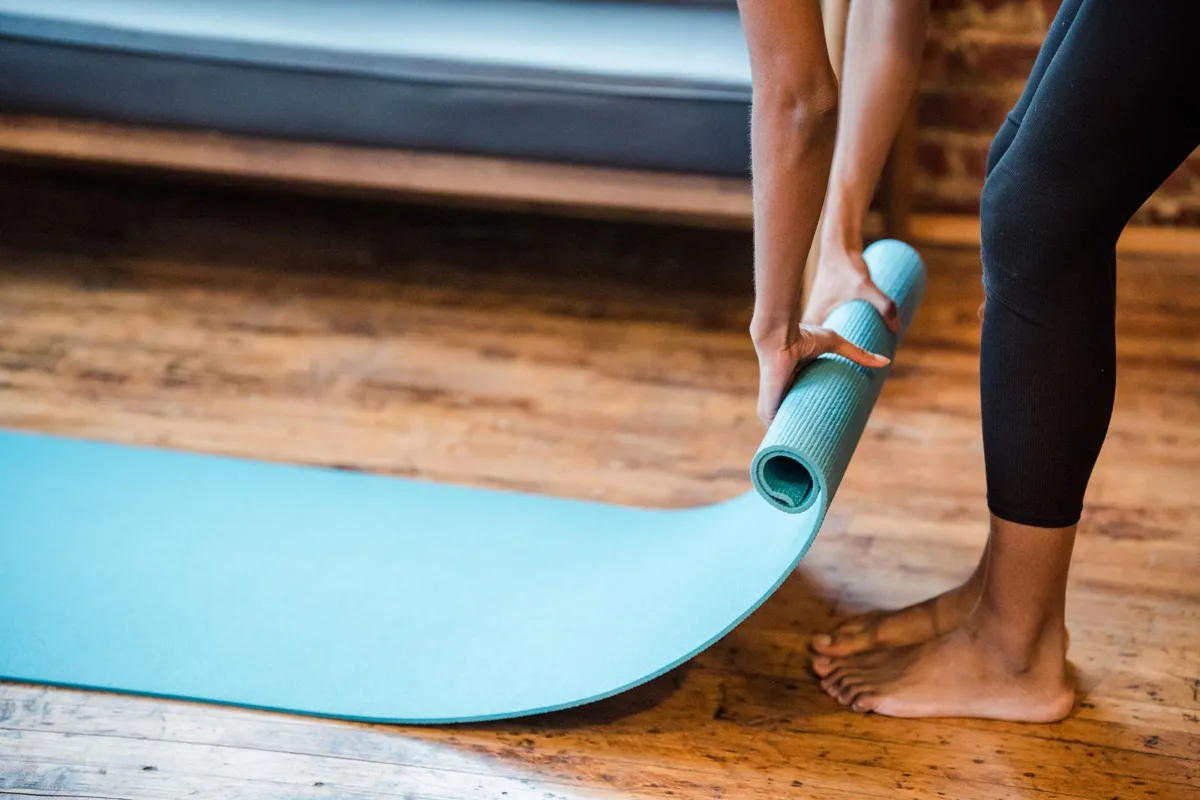
- Roll with the top surface out so the edges lie flat when you unroll.
- Replace when it flakes or loses grip, usually sooner for TPE than PVC.
Training outdoors in the cooler months? Read our tips on how to exercise safely in UAE heat first.
TPE vs PVC Yoga Mat: Buying Checklist
- ☑ You know your practice: sweaty or hot yoga (lean PVC) or gentle yoga, Pilates and travel (lean TPE).
- ☑ For PVC, the listing says phthalate-free, “6P free” or OEKO-TEX certified.
- ☑ For TPE, the listing confirms TPE (not EVA) and gives a thickness of 6–8 mm for yoga.
- ☑ Thickness matches your floor: 4–6 mm for stability, 8–10 mm for knees on tiles.
- ☑ The mat is at least 183 cm long, or longer if you are tall.
- ☑ The underside has a textured, non-slip pattern for tile or marble.
- ☑ You have a grip towel if you sweat heavily.
- ☑ You have a shady place to dry and store it, not a car or balcony.
Our Verdict
In the TPE vs PVC yoga mat debate, there is no single winner, but there is a clear rule for the UAE. If you sweat a lot, practise vigorous or hot yoga, or want one mat that lasts years, choose a reputable phthalate-free PVC mat. If you want something light, soft and affordable for stretching, Pilates or the odd class, TPE is a good buy, as long as you keep it out of the heat and add a towel when things get sweaty. For specific models, see our best non-slip yoga mats in the UAE.
Helpful Gear
- GAIAM 6 mm PVC yoga mat — listed as 6P free PVC with a sticky texture; heavier than TPE but grips longer when you sweat.
Check Price on Amazon → - HERUI 6 mm TPE yoga mat — light, alignment lines and a carry bag; best for gentle yoga, add a towel for sweaty sessions.
Check Price on Amazon → - SKY-TOUCH 10 mm TPE mat — very cushioned for floor work on tiles; too soft for standing balance poses.
Check Price on Amazon → - Eunzel non-slip yoga towel — silicone grip dots and quick-dry microfibre; the easiest fix for slippery hands on any mat.
Check Price on Amazon →
Prices change, so check Amazon.ae for the current price and delivery date.
Frequently Asked Questions
Is TPE better than PVC for a yoga mat?
It depends on what you value. TPE is lighter, softer, usually latex-free and contains no chlorine, so it suits beginners, travellers and anyone who wants a lower-impact material. PVC is denser, grips better when you sweat and usually lasts longer. For hot yoga or very sweaty hands, PVC (or a towel on top of TPE) is the safer choice.
Is a PVC yoga mat toxic?
Modern PVC mats from reputable brands are generally made without the older phthalate plasticisers; many listings say “6P free” or carry an OEKO-TEX certificate. Look for those labels, air a new mat out for a day or two if it has a smell, and avoid very cheap unbranded PVC with a strong chemical odour. PVC is harder to recycle than TPE, which is its main environmental drawback.
Which yoga mat material is best for sweaty hands?
Closed-cell PVC and polyurethane (PU) tops grip best when hands are wet, followed by natural rubber. TPE and NBR foam tend to get slippery as sweat builds up. Whatever mat you choose, a microfibre yoga towel with silicone grip dots is the most reliable fix for heavy sweating.
What is the difference between EVA, PVC and TPE yoga mats?
EVA is a cheap, light foam often used in budget and kids’ mats; it cushions well but tears and slips easily. PVC is dense, sticky and durable. TPE sits in between: lighter and more eco-friendly than PVC, more durable and grippy than EVA, but less tacky than PVC when wet.
How long does a TPE yoga mat last compared with PVC?
With regular home use, many TPE mats start to show wear, flaking or dents within about a year, while a good PVC mat can last several years. Heat speeds up wear on both, so keep your mat out of hot cars and direct sun, which matters a lot in the UAE.
Can I use a TPE mat for hot yoga?
You can, but most people find it slippery once they start sweating. If you already own a TPE mat, put a non-slip yoga towel on top and lightly mist the towel with water before class so it grips from the first pose. If you are buying a mat mainly for hot yoga, choose PVC, PU or rubber instead.
The Bottom Line
PVC grips better in heat and sweat and lasts longer; TPE is lighter, softer and kinder to the planet. Match the material to how you practise, check the safety labels, and protect your mat from the UAE sun. Ready to choose? Compare models in our yoga mat buying guide.